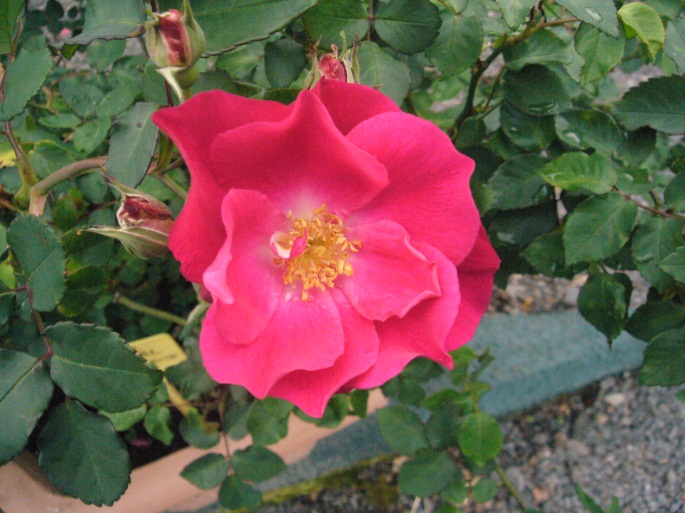
Irene Watts - China Rose

Creator: P. Guillot, France, 1896
Origin: “Mme Laurette Messimy” seed
Flowers: 4 cm
Height: 70 cm

The pink salmon flowers are beautiful and appear continuously until the autumn. The shrub, covered with small shiny green foliage, can be planted in pots.
Dainty Bess - Hybrid Tea Rose

Creator: Archer, England, 1925
Origin: “Ophélia” x “Kitchener of Khartoum”
Flowers: 11 cm
Height: 1 metro

When it appeared in the market, this rose was considered to be the most beautiful rose ever produced. The flowers are large, exuding a light fruity scent, adorned of long wavy pale pink petals. The purple stamens are prominent, which contributes decisively to enhance the beauty of the class of Hybrid Tea.
In warm and temperate climates it blooms almost all year round.

Albertine - Hybrid Wichurana Rose

Creator: Barbier, France, 1921
Origin: “R. Wichurana” x Mrs Arthur Robert Waddell”
Flowers: 10 cm
Height: 4,5 m

Still today this is one of the best-selling climbers around the world.
It is a very floriferous rose and spreads easily. This rose produces dark coral buds that open into very fragrant light pink folded flowers, with little disordered thin petals, flowering in groups of three to seven.
The bush is very vigorous and has abundant glossy green foliage. Thanks to its strong thorny branches, this rose is suitable for climbing trees or large shrubs.
Sometimes it needs to be protected against attacks of mildew, in the year in which this disease is to be feared. Reportedly Barbier intended to honor the memory of Marcel Proust (1871-1922), but another rose breeder anticipated him, by assigning the name of this famous writer to one of his creations.
So Barbier decided to name this rose after one of the heroines of the famous novel. "In Search of the Lost Time." Apart from this, Barbier’s family was responsible for one of the most impressive sets of Hybrid Wichurana ever being produced. The "Barbier et Cie" was founded in 1875 and the process of trade expansion was fast and consistent.
Curiously, for several years, Barbier’s were seen by the public as a reputable nursery trade and production of fruit trees, and were not even considered proficient rose breeders, but later turned out to be. In 1890 René Barbier imported the "Rose Whichurana" from the United States and in its first crossings, he proved to be a talented hybridizer, able to produce the “Alberic Barbier”, “Elisa Robichon”, “Francois Foucard","Paul Transon" and" Rene Barbier. " wichuranas roses
The flowers of these new hybrids were generally larger and more dazling than the U.S. roses and had then produced a wider variety of colors. Most climbers produced by Barbier resulted from crossing with tea roses, in particular the "Souvenir de Catherine Guillot" responsible for seven of its most successful wichuranas "Moulla Adelaide", "Alexander Tremouillet", "Edmond Proust" "Guichard", "Leontine Gervais", "Pinson" and "Valentin Beaulieu."
Almost all the roses produced by Barbier still exists today and have excellent qualities: they are lively, flexible, healthy and have a good flowering.

Paul Transon - Hybrid Wichurana Rose

Creator: Barbier, France, 1900
Origin: “Wichurana Rose” x “L’Ideal”
Flowers: 6 cm
Height: 5 m


The flowers are medium-sized and folded, disposing of a mix of pinkish salmon and terracotta color reflections in the center, appearing individually or in groups of three to five. " PaulTranson " is not a lush rosebush. Nontheless the foliage is beautiful. Unfortunately it is susceptible to mildew. What makes this rose peculiar is that it sometimes repeats flowering in autumn in regions where the climate is mild.
Princesse Louise - Hybrid Sempervirens Rosebush

Creator: Jacques, França, 1828
Origin: “Sempervirens Rose” x “Parson’s Pink”
Flowers: 7 cm
Height: 5 m

Antoine Jacques obtained this rose, as he intended to honor the Princess Louise d'Orleans (1812-1850), the eldest daughter of the Duke of Orleans, and future King Louis-Philippe of France, who married King of the Belgians, Leopold I in 1832.
The red buds of this climber are magnificent and bloom in beautiful white flowers, making quite a contrast, highlighting the subtle beauty of this "sempervirens". The flowers come usually in groups of five to twelve, within its dark green foliage, exuding a sweet musky scent

Cramoisi Supérieur - China Rose
Creator: Coquereau, France, 1832
Flowers: 5 cm
Heigt: 1 m

The flowers are cup-shaped and appear in groups throughout the year. This rose has a magnificent crimson color, the petals have the reverse and the edges of a less intense color, and the same may be said regarding its central petals that have some shades of white.
The effect is undeniably a unique beauty. The scent is light and very pleasant. In hot climates this rose can easily reach one meter in height. The leaves are small, dark green, and are susceptible to attacks from the black spot.
In 1885, a French rose breeder came up with a climber mutation of this rose. Known as "Agrippina", it was a great success in Italy and is under 4 m height.
Jean Sisley - Hybrid Tea Rose

Creator: Bennet, England, 1879
Origin: “Adam” x “Emilie Hansburg”
Flowers: 10 cm
Height: 60 cm

A wonderful and rare rose created by the legendary Henry Bennet. The flowers are folded, quite scented and of a rosy lilac attractive color. The plant has a moderate growth and good foliage, but can be attacked by powdery mildew and black spot when the weather is hot and humid.

Lauré Davoust - Hybrid Sempervirens Rose

Creator: Laffay, France, 1834
Origin: possibly “Sempervirens Rose” x “a Noisette Rose”
Flowers: 3cm
Height: 5 m

This rose is very difficult to classify: for some it is a hybrid of "R. Multiflora ", for others it results from a happy crossing between" R. Sempervirens "and a rose Noisette.
I opt for this last one. But regardless of their genealogy, the truth is that this rose has a unique charm especially during its prolonged flowering. The tiny flowers in perfect pompons, appear in clusters, with a mix of pink and white, very attractive. The bright green foliage is exceptional.
It is unclear who the person who wanted to honor Laffay was, but it may possible to have been a relative of Marshal of the Louis Empire - Nicolas Davout (1770-1823).
Variegata di Bologna - Bourbon Rosebush

Creator: Bonfiglioli, Italy, 1909
Origin: mutation of “Victor Emmanuel”
Flowers: 8 cm
Height: 3 m

The success of the secular 'Variegata di Bologna' is explained mainly due to its exoticism. Its large, globular flowers streaked of a purple-crimson color and quite fragrant, has always caught great attraction among lovers of gardening. Nontheless this is a difficult plant to grow, once it is very susceptible to powdery mildew and black spot, which grows disproportionately
It is undoubtedly a rosebush just to be cultivated by devoted gardeners and in areas with low rainfall in spring.
Sanguínea - China Rose

Creator: Unknown, around 1824
Flowers: 6 cm
Height: 1, 25 m

Also known as "Bengal Cramoisi Double", "Blood-red China Rose," "La Sanguine" or "R. indicates bloody ", this China Rose is simple, but specially beautiful. The fragrant flowers of a bright red becomes purple after some time, have broad petals that fold in different ways giving the plant a particular size.
The leaves are small and dark and the flowers give way to small orange fruits. In hot climates this rose can reach 2 meters in height. Its flowering is continuous.
Britannia - Polianta Rose

Creator: Burbage, England, 1929
Flowers: 3 cm
Height: 60 cm

Quite imposing and full of energy, this rose provides a permanent "festival" of color and joy to the garden. The flowers, are of a simple red, with a white center and appear in multiple groups of thirty to forty year round.
Antoine d’Ormois - Gallica Rose

Creator: Vibert, France, 1835
Flowers: 6 cm
Height: 1, 5 m

The flowers of this rose have a subtle special pink color, one of the most beautiful I know. This rose is darker in the center of the flower and gradually evolves into a lighter color with reflections of white outer petals. The flowers are very bent, however ending up in an almost flat profiling. It is definitely not one of the most known gallicas. It is not even a lush plant. Flowering is delayed. And the flowers usually appear alone.
However and in spite of not having an exuberant character, this rose has a special distinction, able to satisfy the real connoisseurs
Victor Emmanuel - Bourbon Rose

Creator: Guillot Pére, France, 1859
Flowers: 9 cm
Height: 90 cm

Although this isn’t a vigorous rose, its flowers are of a beautiful crimson color and quite folded.
This is a rare Bourbon, with some affinities to the “Variegata di Bologna”
Victor Emmanuel II (1820-1878) was the first king of Italy.
R. Rugosa Rubra - Wrinkled Rose

Origin: Japan
Flowers: 10 cm
Height: 2 m

Also known as "R. Rugosa Atropurpurea" this rose produces beautiful ruby flowers, where the bright yellow stamens stand out. It blooms throughout spring and summer. On the threshold of autumn, one can easily highlight its orange reddish fruits. The foliage is similar to the "R. Rugosa".
Madame Edith Helen - Hybrid Tea Rose

Creator: Dickson, Ireland, 1926
Origin: seed of a “Mrs. John Laing”
Flowers: 12 cm
Height: 1, 5 m

After its introduction, and for some years, this rose was the favorite of the exhibitions. The flowers, quite fragrant, are filled with numerous petals of a bright pink color and the bush is vigorous and compact, disposing of healthy thorny foliage that is rarely attacked by mildew. Madame Edith Helen (1879-1959), the Marchioness of Londonderry, was responsible for the creation of the gardens of Mount Stewart in Northern Ireland.
Nur Mahal - Hybrid Musk Rose

Creator: Pemberton, Great Britain, 1923
Origin: “Château de Clos Vougeot” x a seed of a Hybrid Musk Rose
Flowers: 7 cm
Height: 3 m

This is another high quality rose created by the Rev. Joseph Pemberton, that can be used as a shrub or as a small climber. Quite imposing, this rose disposes of semi folded flowers and has a spices fragrance. These roses are bright red enhanced by golden stamens and a white center, with clearer lists on the reverse of the petals. The flowers appear in groups of ten to twenty-five against a backdrop of dense bright green foliage.
"Nur Mahal" is a tribute from Pemberton to the powerful woman of India´s Emperor Jahangir, to whom legend attributed the discovery of the famous " rose smell."
Miranda - Portland Rose

Creator: Arthur of Sansal, France, 1869
Height: 1, 5 m

Here is a "Portland" increasingly difficult to find.
Its flowers are large, folded, cup shaped and of a glossy pink color that appear in profusion in spring. Sometimes they can bloom again in late summer, but the flowers can not stand the rain and humidity. The foliage is bright green.
Canary Bird - Hybrid Xanthine Rosebush


Origin: Probably: “Hugonis Rose” x “Xanthine Rose”
Flowers: 5 cm
Height: 2 m

This is one of the first roses to bloom at the beginning of April. The flowering lasts about thirty days and is spectacular, despite the simplicity of the flowers of five petals, slightly fragrant, in a bright canary yellow.
The branches are dark and the leaves are small.
This is an elegant shrub that does not require special care.
Mary Wallace - Hybrid Wichurana Rose

Creator: Van Fleet, US, 1924
Origin: “Wichurana Rose” x “Hybrid Tea Rose”
Flowers: 8 cm
Height: 5 m


This climber, which was marketed by the "American Rose Society", produces large flowers, semi folded of a bright pink color. Unfortunately the flowers have a tendency to lean on their own weight, which takes away part of its beauty.
The leaves are bright green and quite resistance to diseases.
Mutabilis - China Rosebush

Origin: Italy, around 1900
Flowers: 6 cm
Height: 2 m


This rosebush is still widely grown in Italy. It was introduced by Henri Corrévon, a Swiss rose breeder, who called it "Ideale type".
This rose is suitable for hot and temperate climates where it never stops blooming. The flowers change color in a surprising way: first, yellow and orange suede, then pink, fainting into purple later on. The petals, very elegant, assume multifaceted contours, equally gracious.
"Utabilis" can be grown as a bush or a creeper. In some regions in Italy, it is used as a hedge as well.